Lingerie Francaise: A History of Underwear

Lingerie exhibit

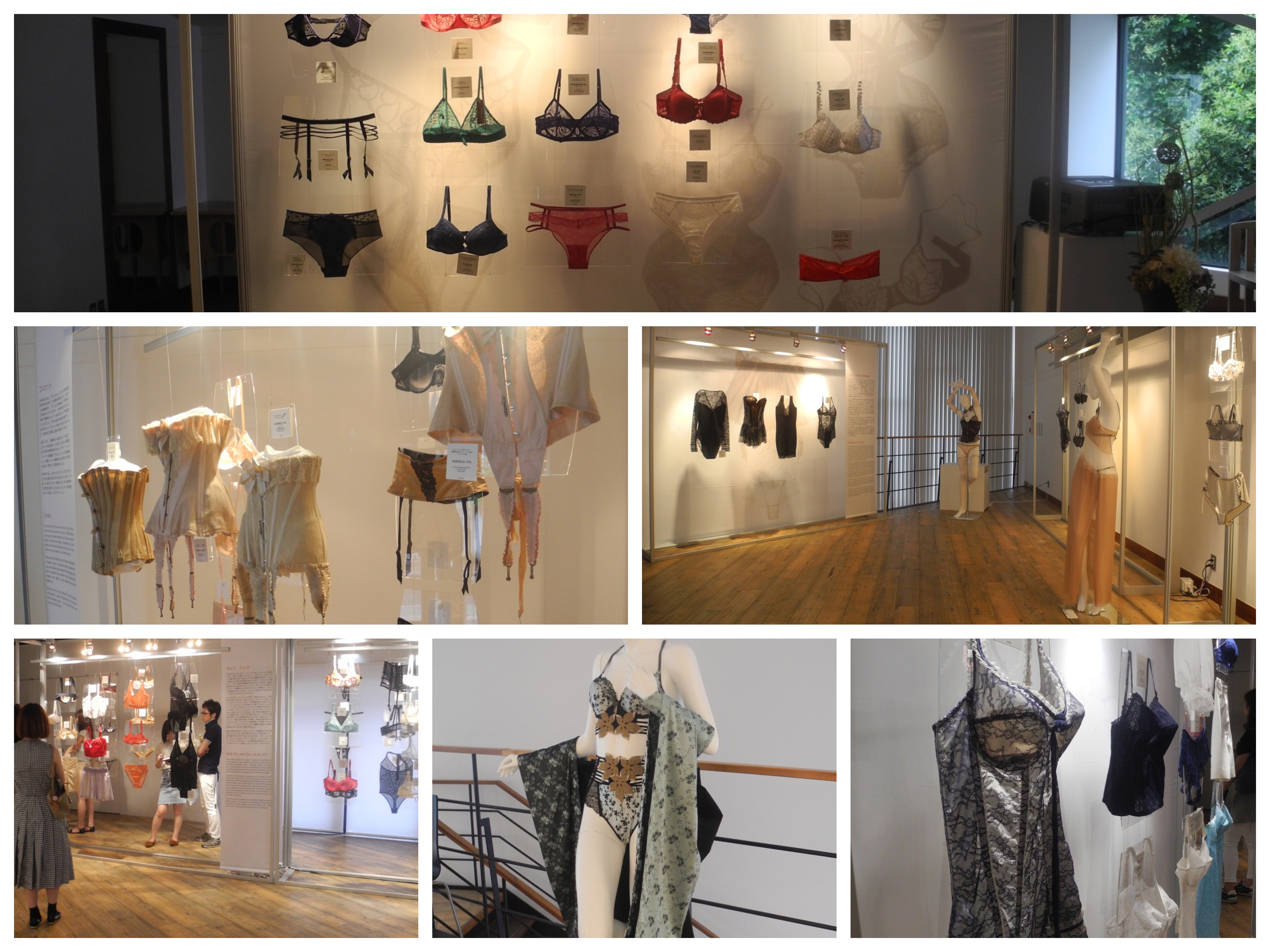
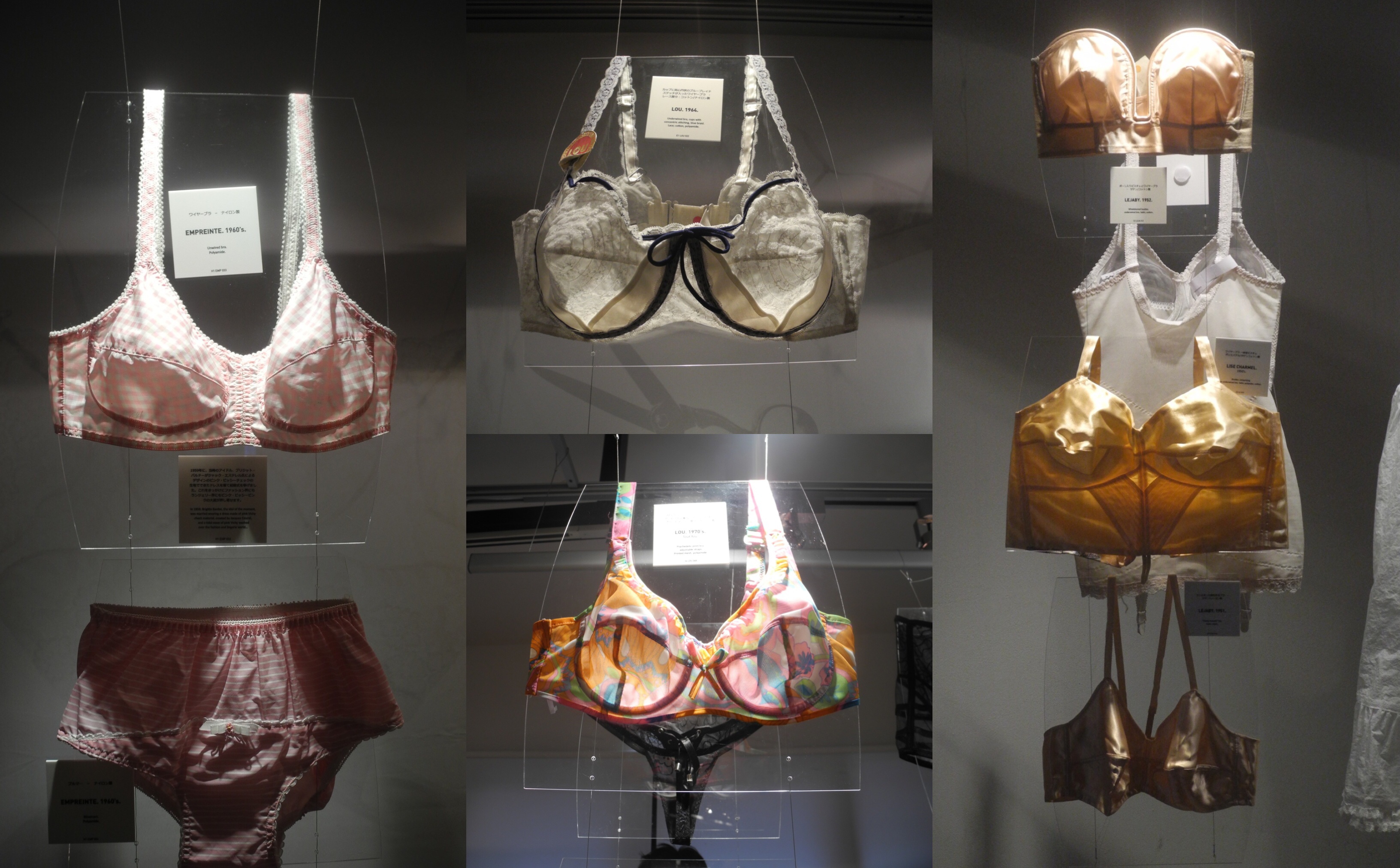
One of the best things about Tokyo is the fact that there are actually a decent number of things you can do for free or almost free. For example, most department stores have gallery and exhibition spaces and host a variety of interesting and well-curated shows. There are also other exhibits in various spaces all over the city such as the Lingerie Francaise Exhibit I saw on the weekend in Omotesando.

I read about this exhibit in the Savvy Tokyo site and thought I’d check it out. It was free but very well done and also offered a detailed brochure in English. It has some big sponsors in the lingerie world: Aubade, Barbara, Chantelle, Empreinte, Implicite, Lise Charmel, Lou, Maison Lejaby, Passionata, Princesse Tam.Tam and Simon Perele just in case you were wondering who the world leaders in underwear are.

Basically it looks like there’s not too much new under the sun. Many of the current corset styles are based on some of the first corsets made over a hundred years ago, though the invention of elastic, nylon and Lycra has made things a lot more comfortable. After WWI the corset was replaced by a bra and girdle (often custom-made) which evolved into machine-made versions that were designed to create whatever female silhouette happened to be in vogue at the time–slim hipped, curvy, hourglass. Which is where we are now…whatever your preference happens to be, there is likely a lingerie designer/manufacturer that produces your ideal underwear.

In Japan the preference happens to be very lacy and embellished (ruffles, lace, ribbons, beads) and almost always padded or heavily lined. The idea of the T-shirt bra (i.e. very smooth to allow for a clean line under a t-shirt) does not seem to be a look they are interested in exploring. Also thong underwear is not popular and is difficult to find…also very expensive. The 5 for $25 deal that is commonly seen at La Senza and Victoria’s Secret simply doesn’t exist here in the land of the rising sun. Make no mistake, there is some very lovely lingerie here but it tends to lean more towards the ‘granny knicker’ size than the ‘G-string’ end of the spectrum. Also tends to be cute (kawaii) not sexy…Karis and I actually saw a bra and knickers set made of terry cloth. Yes, for a grown-up 😉
Lingerie-2

Better. Stronger. More heat-resistant.

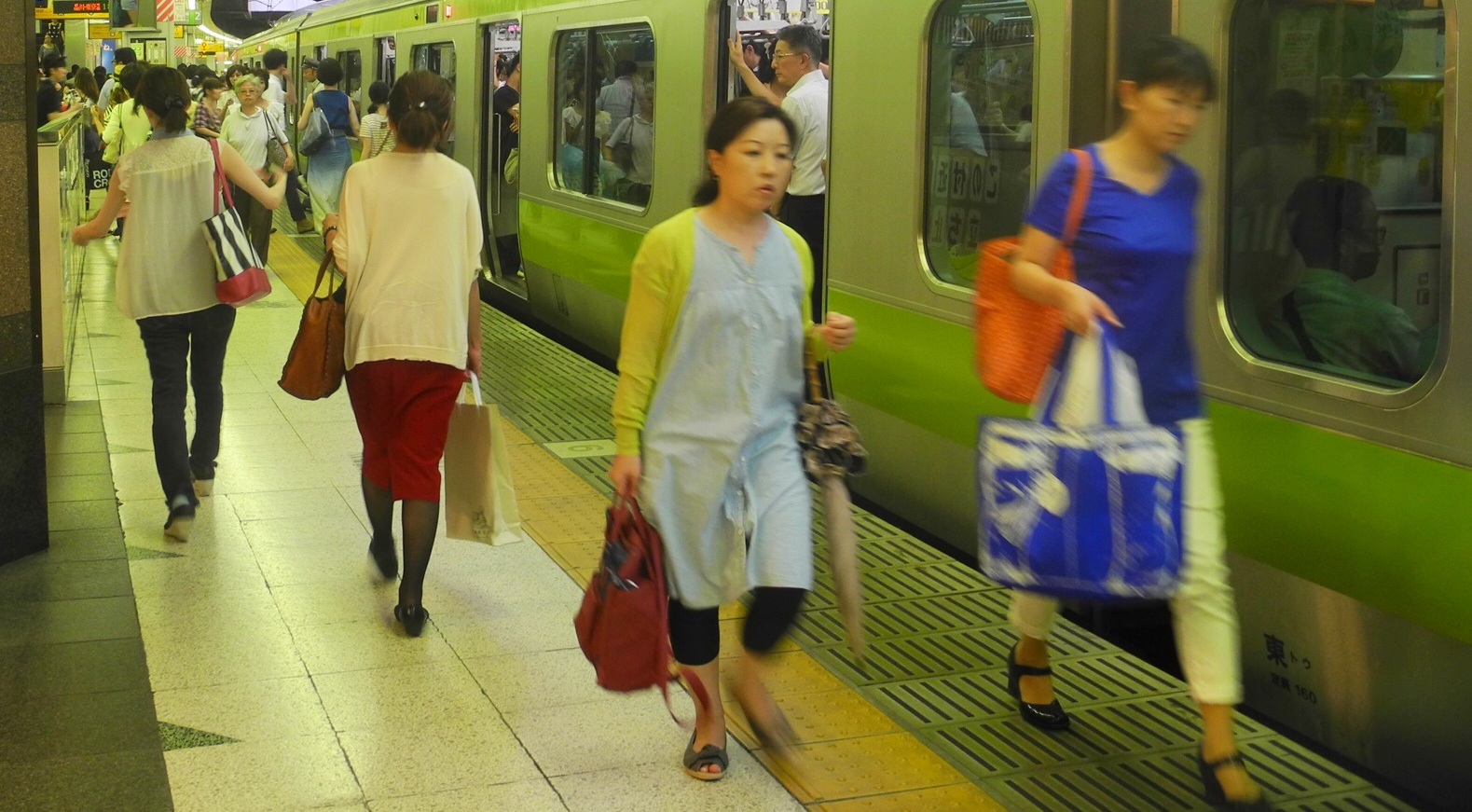
SweatingThe people here in Tokyo are better than me. In many ways, but one in particular: they are not wussies about the heat. If you’ll notice in the photo, which is taken inside Shibuya station, there is a woman wearing stockings and a cardigan. I took this photo on Friday. It was 34 degrees (‘feels like 42’) outside, and it’s much hotter in the bowels of the station though the actual trains are air-conditioned.

The people here are stoic. It’s almost as if they dissociate themselves from the heat, then they won’t be hot. According to a friend who lives here, dissociation and distancing oneself is a necessary survival mechanism in a city this big. I see his point…it’s pretty orderly and polite all in all, otherwise anarchy would quickly take over. Anyway, I digress. The heat is insane. Everyone carries handkerchiefs here and in the summer, it’s basically the equivalent of a small washcloth to literally mop the sweat from your fevered brow. They are quite fashionable, embellished with all manner of brand names ranging from Betsey Johnson to Kitson to Laudree (which is a French baker specializing in macarons). They also have special tissue paper that soaks the oil off your skin. However, many people don’t appear to actually be sweating at all. These are often women, dressed in full kimono or in stockings, a dress and a cardigan. Stockings, as in nylons or pantyhose…with high heels. It actually boggles the mind. To add insult to injury, most of the mid-range and cheap clothing here is polyester (an abomination from biblical times) so it doesn’t even breathe. No cheap linen and cotton from Old Navy. They do have The Gap, Zara and H&M but it’s not as affordable as you would expect, though the Japanese equivalent, Uniqulo, has some good deals.

It’s also a more formal society here so you wouldn’t be seeing casual cotton shorts and T-shirts in the city anyway. Often when women and young girls wear shorts, they wear them with stockings; sheer or skimpy tank tops are usually worn with a camisole and they have special arm gloves to protect your you from the sun should you be wearing a short-sleeved shirt. Men wear full on suits (also polyester) with long-sleeved shirts and ties and many employees and blue-collar workers wear uniforms…also polyester. It’s a bit more casual on the weekend but still, on the whole, people wear a lot more clothing despite the heat. I’m not sure how they do it… Karis and I seem to get the beginnings of heat stroke whenever we’re out for more than an hour. Maybe it’s a Zen thing? Probably not something I’ll be mastering any time soon.

Pinball for grown-ups.

Nostalgic for the bright lights and bad colour combos and the friendly neighbourhood pachinko parlour

Nostalgic for the bright lights and bad colour combos and the friendly neighbourhood pachinko parlour

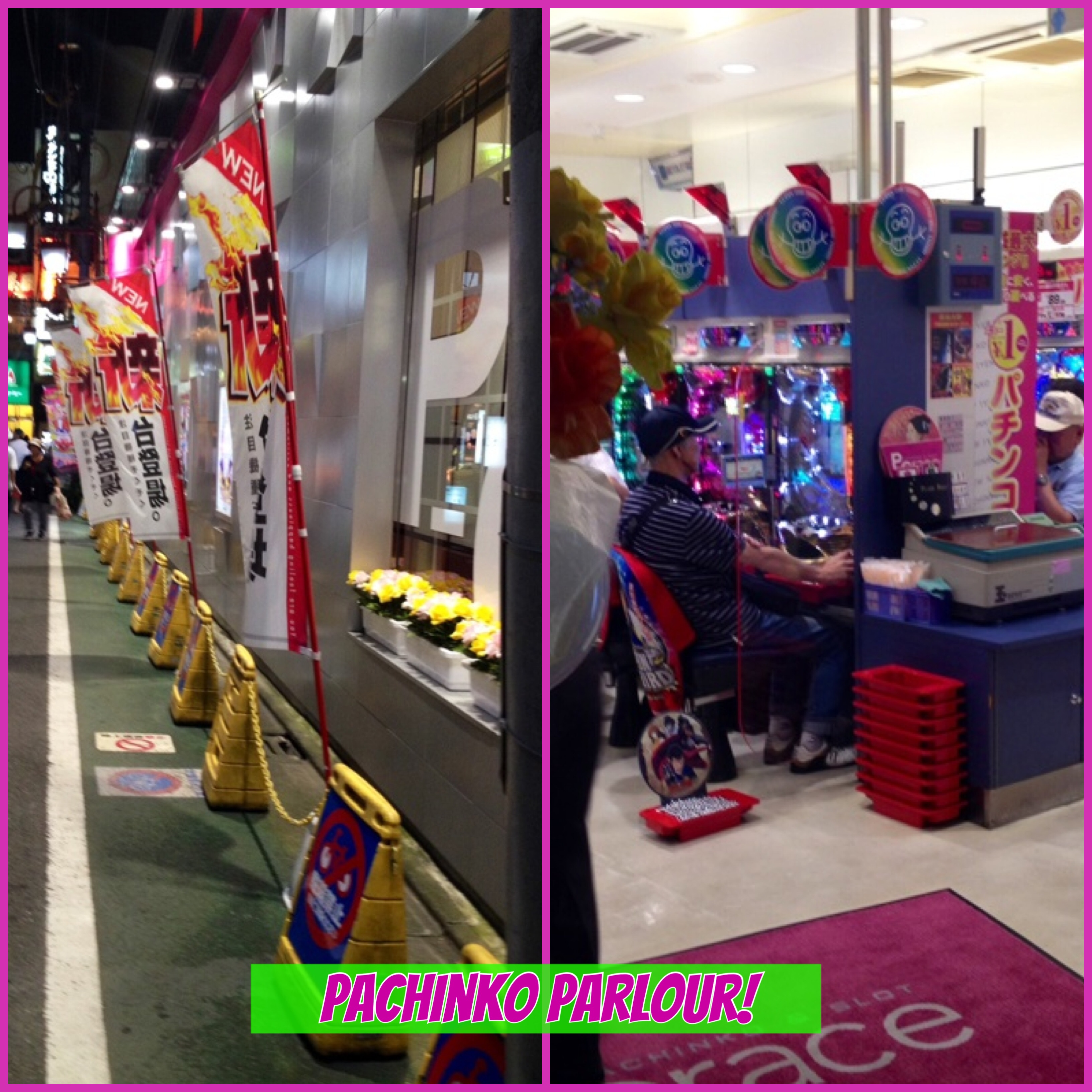
I was out and about the other night, a few train stops away from Shibuya in a somewhat more residential area when I saw it…a pachinko parlour! In both of my previous apartments in Tokyo in the 90s, I was out of the CBD (central business district for those of you who have happily forgotten high school geography) where pachinko parlours abound. Bright and flashing lights, horrendous colours clashing all surrounded by banners and fake flowers.

What is this pachinko you may ask. Basically an arcade for grown-ups. The game is a lot like pinball but apparently the point is to collect up as many little balls as possible. You then exchange them for prizes on site or coupons which you can apparently exchange for cash offsite. Gambling for cash is not allowed under Japanese law. Apparently gambling for coupons that can be exchanged for cash two doors down is ok 😉

A good time was had by all.

Shinjuku Eisa Matsuri Festival_2 Shinjuku Eisa Matsuri Festival

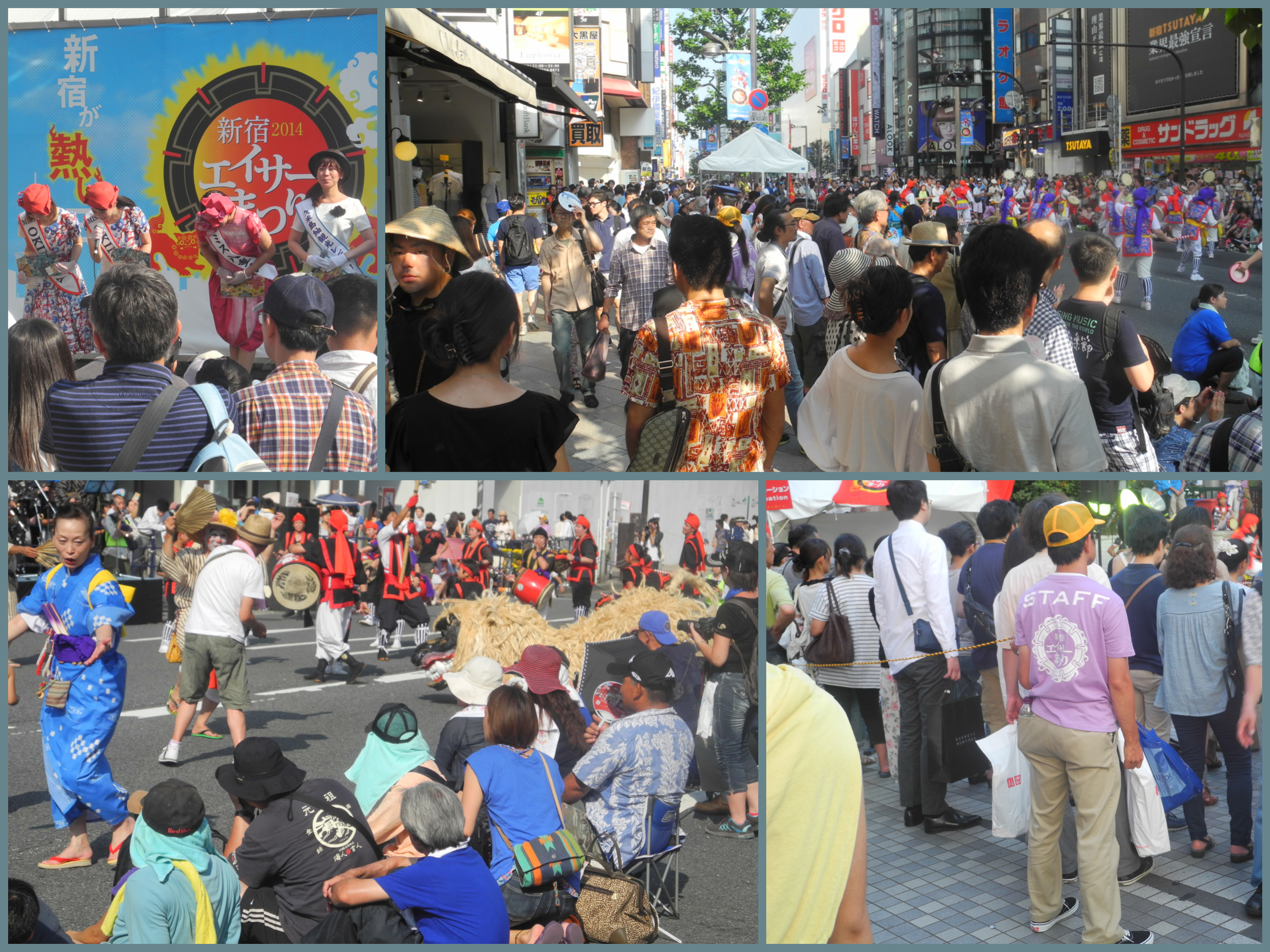
I went to my first official festival in Tokyo today, the Shinjuku Eisa Matsuri Festival: “The Eisa Matsuri Festival originates in Okinawa as a ritual of kyu bon (old bon), to honour the spirits of ancestors and pray for the well-being of families and the prosperity of businesses. Teodori hand dancers, sanshin three-stringed instrument players, jutei singers, clown-like characters… form a procession and dance through town to the beat of taiko drums large and small. This nationally renowned traditional event from Okinawa came to Shinjuku, Tokyo and grew into a symbol of summer. This year marks the 12th holding of the festival.”

Japanese festivals are a great way to spend an afternoon…the dancing, the music (especially the drumming) and the crowds…oh the crowds. I totally don’t recommend festivals if you are in the least bit agoraphobic, actually, I’d avoid Tokyo in general as it’s pretty much always crowded. That being said, the crowds are pretty orderly. They have tons of staff (and police) to control the flow of people, to keep passageways free and to ensure everyone can see. If you want to get closer, you just ask and you will politely be invited to step on the other side of the rope which is there to keep an open throughway. When you consider the heat (‘feels like 41 degrees’), it’s actually amazing that there are no fights, no pushing, no bad behaviour of any sort. The homeless dudes (yes, there are homeless people here) drink their sake in the shade and the families just walk on by. There was even one little blond boy who lost his mum. He was just chatting away to a policeman and some festival organizers until his frantic mum found him. No panic, just follow the “lost-child plan” though I’m sure the fact that it was a non-Japanese speaking blond kid threw them for a bit of a loop.

Apparently this festival originates in Okinawa and I was lucky enough to happen to go to Isetan department store (LOVE Isetan) where their special event space on the 7th floor was a one-day market for Okinawan specialties–food, sake, clothing, pottery and all sorts of handicrafts. Now THAT was crowded, but again, everyone patiently waits their turn to be served. No pushing. Line-ups don’t seem to be any sort of deterrent here. I guess people get used to them. I’m still not though, can’t wait in a lineup of twelve people for snacks no matter how delicious they look. There’s always a 7-11 or two on the way home…

Tokyo for everyone.

Eisa Matsura Festival participants and the Braille pathways I keep tripping over ;-)

Eisa Matsura Festival participants and the Braille pathways I keep tripping over 😉

Accessibility isn’t the first thing you would likely think of when Tokyo comes to mind; however, they’ve made a valiant effort with elevators, ramps, stair lifts and a raised Braille pathway along the sidewalk. Most packaged products also have Braille labels. Do we have that in Canada? I’m thinking we don’t but I could be wrong as it may be one of those things you don’t really notice unless it pertains to you or when you’re in a foreign country and everything is novel. Anyway, today must have been my day to notice how the Japanese treat the disabled or partially-abled. I’m not sure what the correct term is these days. I’ve been here since June 30 and scuffled around, stubbing my toes a few times, on the raised yellow sidewalks but I hadn’t seen one blind person in Tokyo using the aforementioned pathways. Today I saw four blind people–one in the subway station and three at the festival (see below). I’m not kidding AND I’m happy to report they were using the raised yellow sidewalk and it seemed to be fulfilling its purpose guiding people safely through the city and subway stations. Personally, I can barely figure out the subway stations and I can see so I have deep respect for those who navigate this crazy place with any sort of disadvantage beyond not speaking or reading Japanese.

Today I decided to go to the Eisa Matsuri Festival in Shinjuku. There was another festival in Kagurazaka but it necessitated a longer time on the subway and a change of trains and it was simply to hot to cope. Shinjuku is a no-brainer–three stops on the Yamanote Line, 160Y. It was, as usual, ridiculously hot–34 degrees but ‘feels like’ (a term I have grown to hate) forty-one degrees; however, this seems to be the way of things and I can’t simply stay inside all day.

So you’re probably wondering how accessibility, the blind, the weather and a festival all fit together. Well, the weather is simply an aside that I can’t help but mention as it is truly oppressive and hard for me to overlook. The other three do come together nicely. I’ll write more about the festival later but the coolest thing about it was that there were kids with both mental and physical disabilities completely participating in the dancing and drumming. I didn’t actually notice any difference between the kids until the one young man in the photo turned towards me and gave me a huge smile. It was a fun experience, despite the heat and I figured if they’re out in the sun dancing and drumming I should stop whining and take a few photos!

Art Attack. Ueno Park, part 4.

national museum of western art

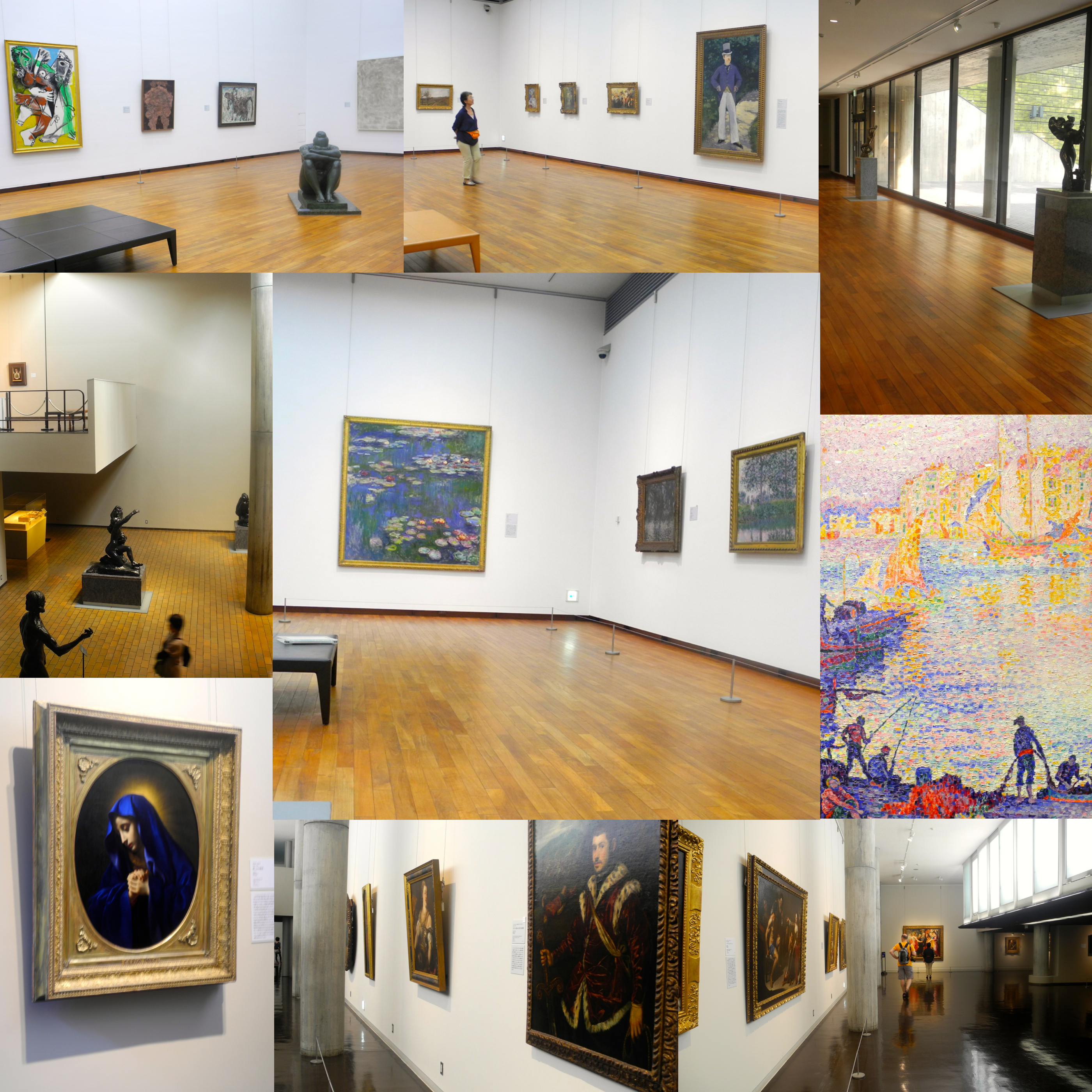
If you’re into art, Tokyo is a great place to be. Not just Asian art, but ALL art. Back in the heyday of the Japanese economy, there were many successful companies and businessmen in Japan. Many of whom bought art. The National Museum of Western Art came to be as  a result of one of those early and inspired collectors, Kojiro Matsukata (1865-1950). Matsukata was a wealthy shipbuilder, who was educated in America (Yale) and travelled widely in Europe. He began collecting in the middle of WWI and continued until the late 1920s. His goal was to create a museum to share these great works with the public and indeed, he began plans to do so; however, the economic crisis of 1927 forced him to sell the majority of his works except for an unknown number of pieces that remained stored in Europe. Many works were lost in an undocumented fire in the UK, but the French government confiscated approximately 400 works stored in France as enemy property at the end of WWII. They were housed and cared for at the Musee Rodin and eventually returned to Japan by the French in 1959 with the proviso that a museum be built to house them. Thus the National Museum of Western Art, designed by Le Corbusier, opened in 1959 to showcase the Matsukata Collection.

The museum itself is an amazing building filled with natural light, pillars to allow the free flow of air, a large ramp (instead of a staircase) from the entrance to the first floor to encourage visitors to take in the vista of the changing levels, various mezzanines and long horizontal windows. Le Corbusier created the modular system of proportions and used it to design the museum. Click here for more on Le Corbusier and his design.

So back to the museum. It was lovely, the art was beautifully displayed, it wasn’t crowded and it was mercifully cool. The had a special exhibition of rings (jewellery) from the Hashimoto Collection which was very well done as they incorporated clothing and paintings that corresponded to specific pieces which made it much more interesting…I find endless displays of jewellery and artifacts a little tedious. The Louvre comes to mind. A heathen, I know.

Anyway, this is only one of many museums with Western art in Tokyo. Last week I went to the exhibits at The National Art Center, but there’s also The Bridgestone Museum of Art (yes, the tire company) that has an amazing collection of 19th century European art; and the Sompo Japan Museum of Art (yup, an insurance company) that houses one of Van Gogh’s Sunflower paintings and other 19th century European painters as well as Japanese artists. Not to mention the amazing collections of Asian art, sculpture, Japanese woodblock prints, contemporary paintings and installations, calligraphy and don’t forget the PAPER MUSEUM! Stay tuned…

One step closer to the nunnery. Ueno Park, part 3.

Ueno TempleApparently there are many temples and shrines in Ueno Park. This one, Benten-do is the only one I had the actual strength to visit. Based on the fact that it had a big gong in the building, I figured it was a Shinto shrine. Shinto is a general respect for all the gods…sort a pantheistic approach and co-exists easily with Buddhism in Japan.

Upon entering, there is usually a fountain to purify yourself. You are meant to rinse your cupped hands, one at a time and then your mouth. You must transfer the water from your cupped hand to your mouth, not directly from the ladle as that would make the ladle impure for everyone else. Spit the water on the ground. I don’t see people spitting that often…must be one of those customs that is going by the wayside.

You can light incense and put it the sand in the incense-burner thing (Japanese name unknown). You light it (buy it first) and then wave it around to blow out the Ueno temple 2flame but not actually blow out the flame. The smoke is believed to be powerful and healing and people usually waft it towards themselves.

When entering the main building, the offering hall, take off your shoes if it’s indoors.  Actually, you have to take off your shoes at a lot of places that are indoors in Japan, particularly temples and shrines. Approach the Offertory box and throw your coin in. If there is a gong that’s when you ring it to get the attention of the gods. Then you bow twice (some say this is when you make your wish in your heart), clap your hands twice, bow again and pray for a bit.

If you are at a Buddhist temple, there is no gong and you shouldn’t clap as you are praying to the Buddha to help you attain salvation/nirvana not to a group of gods. I guess is that Buddha does not like to be summoned by clapping or loud gongs.

There are very cool little bookmark-like things as well as things that look like cell phone charms. These are called O-mamori and are good luck charms that can be quite specific types of good luck (new job, success on exams, health, wealth, marriage, baby etc). There are also fortunes you can buy called Omikuji that are good or bad luck. Traditionally you would leave the bad luck ones at the shrine thereby ridding yourself of the bad vibes whilst the good luck ones were taken home…but apparently you can increase or multiply your luck by leaving a good fortune at the shrine (which is what I did). The wooden plaques are called ema and you write your wish on the back and hang it on a special spot at the shrine. So there you have it…what to do at a Japanese shrine or temple should you happen to run across one 🙂


Epic storms of warm water.

Lightning collageAn homage to my Thunder Bay roots. I’m not from there but both my parents are and much of my extended family lives there. They would LOVE the thunderstorms here. This is the second one we’ve had in the last few days and they are loud. Loud enough to make the house shake and the windows rattle. The lightning is blinding…check out the blurry photos. The ones that look light daylight are lightning flashes. Epic. Luckily the very kind man from the restaurant (MILAN, Italian place down the road…lucky we didn’t go far) lent us an umbrella…not that it really helped. My flip-flop fell off as we were crossing the road and it nearly floated away. The puddles are warm like bath water.

Ueno Park is big. Part 2.

liliesThe water lilies are amazing! It’s like a forest of water lilies if you can have such a thing. Apparently Ueno is not the best part of town…lots of sex shops and weird bars but not really an issue during the day. I did meet a very friendly transvestite whilst admiring the water lilies, but she/he just wanted to know where I was from, if I liked Japan and if I needed any help finding anything. On my way to the Shitamachi Museum there was an area with people selling used goods. It looked like a bunch of junk so I didn’t spend much time. Also it seemed that there were mainly drunk men hanging out in the area.

Back to the water lilies. I had no idea they could get so tall. They cover the entire pond/lake and are a lovely oasis of green in the middle of the (sort of dirty) city. The wave around in the breeze and the light is amazing. Monet would have appreciated them 🙂

Ueno Park is big. Bigger than I remembered. Part 1.

ShitamachiAnother art gallery/museum day today. It was ridiculously hot and the museums are like refrigerators so I thought it would be a practical expedition. I had taken a few notes on Ueno Park earlier and noticed that there were a lot of museums there AND quite a few temples and shrines as well. It never sounds that big on paper. I think it would realistically take a few days to see them all. It’s huge. Like Stanley Park but with museums. Maybe bigger.

I headed out at 1pm, paid my 200Y and hopped on the Yamanote line which is the circle line that goes around the city. It’s above ground and I wanted to check out the scenery which is why I chose it instead of the subway. So arrived at Ueno and thought I’d head to the Shitamachi Museum first (free with my Grutto pass). Exiting the station, the heat is like a wall…so ridiculously hot.

The Shitamachi Museum was pretty cool. Very small. It’s a replica of what the area would have looked like in the Edo period showing houses that ordinary people would live in as well as the merchant class and the working class. Much like the old-fashioned street scene at the Royal BC Museum in Victoria. Sorry the pix are a big blurry but I couldn’t use the flash. You could actually take your shoes off and walk around in the rooms. Very little floor space but super-organized. Not that I expected anything less 😉